 EN
 CN
Alumina Ceramic vs. Zirconia Ceramic: A Guide to Material Selection
Alumina and zirconia are the two most widely used and common types of ceramics in industrial applications. Many buyers and engineers focus solely on price and fail to consider the appropriate application: they use alumina ceramics where wear resistance is needed, only for it to shatter at the slightest impact; or they use zirconia ceramics where insulation is required, resulting in over-specification and wasted costs. Today, we’ll explain the diiference betwwen alumina and zirconia all clearly in plain language:
1. Comparison of the Properties of Alumina and Zirconia:
| Alumina and Zirconia Material Property Technical Data Sheet | ||||||||
| Properties | Units | 99.99% Al2O3 | 99.7% AI2O3 | 99.5% Al2O3 | 99% A12O3 | 97% Al2O3 | 95% Al2O3 | ZrO2 |
| Permeability | Gas-tight | Gas-tight | Gas-tight | Gas-tight | Gas-tight | Gas-tight | Gas-tight | |
| Density | g/cm2 | 3.95 | 3.94 | 3.9 | 3.8 | 3.75 | 3.7 | 5.9-6.0 |
| Hardness | Mohs Scale | 9 | 9 | 9 | 9 | 8.9 | 8.8 | 8.8 |
Bending Strength (Typical 20℃) | Mpa | 375 | 375 | 370 | 340 | 320 | 304 | 1200 |
Compressive Strength (Typical 20°C) | Mpa | 2300 | 2300 | 2300 | 2210 | 2100 | 1910 | 2500 |
| Max Working Temperature | ℃ | 1750 | 1750 | 1750 | 1700 | 1650 | 1500 | 1050 |
| Coefficient of Thermal Expansion (25°C to 800°C) | 10-6/° | 8 | 7.8 | 7.8 | 7.7 | 7.6 | 7.5 | 10 |
| Fracture Toughness | MPa*m1/2 | 4.4 | 4.3 | 4.3 | 4.2 | 4 | 3.8 | 10 |
| Dielectric Strength (5mmThickness) | AC-kv/m m | 9 | 8.7 | 8.7 | 8.7 | 8.5 | 8.3 | 9 |
| Dielectric Loss (25°C@1MHz) | <0.0001 | <0.0001 | <0.0001 | 0.0001 | 0.0002 | 0.0002 | 0.001 | |
| Dielectric Constant | 25°C@1MHz | 9.8 | 9.7 | 9.7 | 9.5 | 9.3 | 9.2 | 29 |
| Thermal Conductivity (25°C) | W/m-K | 30 | 30 | 30 | 29 | 27.5 | 25 | 2.5 |
2. Comparison of the Advantages of Alumina and Zirconia
(01)Alumina Ceramics: The Top Choice for Cost-Effective Insulation
Core Features: High insulation, corrosion resistance, and cost-effectiveness, especially for 95 alumina
Weaknesses: Poor toughness, high brittleness; susceptible to impact and compression; extremely prone to chipping and fragmentation under high-frequency impact conditions.
(02) Zirconia Ceramics: The Champion of Impact Resistance, Wear Resistance, and Toughness
Core Features: High toughness, ultra-high wear resistance, impact resistance
Weaknesses: Average insulation performance; higher price than alumina; poor cost-effectiveness for purely static insulation applications.
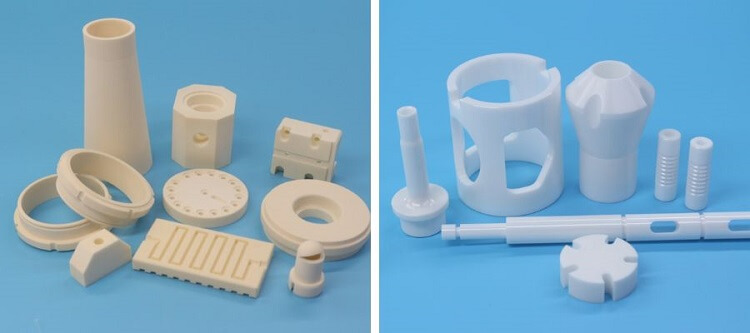
3. Typical Applications of Alumina and Zirconia
Many purchasing professionals and engineers who are not familiar with advanced ceramics often wonder: When should I choose alumina, and when is zirconia essential? Alumina ceramics are the industrial workhorse: they feature high hardness, stable insulation properties, and resistance to acid and alkali corrosion. With mature mass production and affordable pricing, they are the material of choice for the vast majority of routine applications.
Suitable Applications:
✅ Electrical insulation and high-temperature insulation structural components
✅ General-purpose corrosion-resistant and anti-scaling ceramic components
✅ Static supports and high-temperature mounting bases
✅ Wear-resistant applications with controlled budgets and no high-frequency impacts
The greatest advantage of zirconia is its exceptional toughness, which addresses the common issues of brittleness and cracking found in ordinary ceramics. Its wear resistance far exceeds that of alumina, making it suitable for dynamic, high-stress operating conditions.
Suitable Applications:
✅ Bushings and wear-resistant sliders subjected to reciprocating motion and high-frequency impacts
✅ Dynamic components exposed to high-speed friction and prone to wear
✅ Thin-walled, slender, and chip-prone precision structural components
✅ Applications with high requirements for service life and impact resistance
4. Cost and Price Differences Between Aluminum Oxide and Zirconia
Aluminum oxide ceramics are less expensive than zirconia ceramics. The raw material price for zirconia is approximately 46,000 yuan per metric ton, while that for aluminum oxide is significantly lower at 2,589 yuan per metric ton. The main reasons include:
Raw Material Costs: Aluminum is abundant in the Earth’s crust and inexpensive; zirconia, however, requires yttrium oxide—a rare earth element—as a stabilizer, which has limited sources and high costs.
Machining Costs: Zirconia is very hard, making it difficult to machine; grinding takes a long time and results in high tool wear. Aluminum oxide is relatively easy to machine and causes minimal tool wear.
Sintering costs: Zirconia has poor thermal shock resistance and requires higher sintering temperatures, resulting in higher sintering costs compared to alumina.
In summary, if cost and ease of processing are the primary considerations, alumina is the more economical choice; if there are higher requirements for wear resistance, toughness, or service life, zirconia is more suitable, though its price is significantly higher.
5. Case Study
Case 1: For example, one of our customers recently enquired about custom ceramic plungers based on a drawing. The unit price was US$179.50 for 95% alumina and US$217.60 for zirconia. Of course, the final price also depends on the order quantity.
Case 2: Many customers mistakenly use alumina for wear-resistant bushings. It’s not that alumina cannot be used for bushings. Rather, under ultra-high frequency impact during equipment operation, alumina ceramic bushings may be prone to cracking in a ceratin time.within a few days. After switching to zirconia ceramics, impact resistance and wear resistance improved dramatically, directly extending component lifespan several-fold and reducing costs associated with frequent part replacements and downtime.
6. Alumina vs. Zirconia: How to Choose the Right Ceramic Material
Choose alumina: Static insulation, corrosion resistance, high-temperature resistance, cost control
Choose zirconia: Dynamic friction, high-frequency impact, long service life required
7. Custom Alumina and Zirconia Ceramics
Unsure which material is suitable for your operating conditions? If you have custom drawings, send us a direct message. We’ll provide free assistance with material selection, drawing review, and process evaluation to ensure a precise match with no waste, no failures. Mingrui Ceramic handles the entire process in-house—from powder preparation→ forming → sintering → precision machining → testing—and supports both small-batch prototyping and large-scale production.